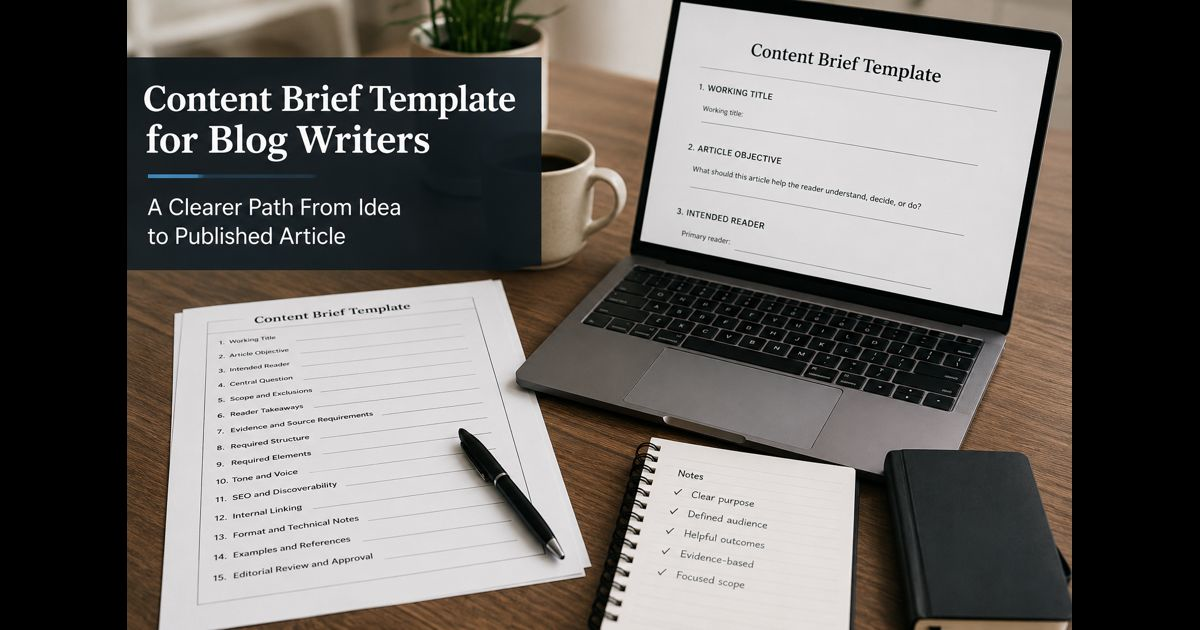
A content brief template for blog writers gives every assignment a clear purpose before drafting begins. It defines the reader, the question the article should answer, the evidence it needs, the boundaries it must respect, and the practical outcome it should deliver. That clarity prevents two expensive problems: a well-written article that does not meet the editor’s needs and a keyword-led page that adds little for the reader.
A good brief is not a rigid script. It is a decision document. It tells a writer what must be true when the article is finished while leaving room for sound judgment, original examples, and a natural voice.
What a Content Brief Should Accomplish
The best briefs make the assignment understandable without forcing the writer to guess. Before research begins, the writer should know:
- who the piece is for;
- the specific problem or question it addresses;
- what readers should be able to understand or do after reading;
- the scope of the topic and what is outside it;
- which claims require evidence;
- the appropriate format, depth, and deadline; and
- how the work will be reviewed.
This is more useful than giving a title and a target word count alone. A title can suggest a direction; it cannot explain the reader’s level of knowledge, the evidence standard, or the difference between a useful example and an unsupported claim.
Content Brief Template for Blog Writers
Copy the following sections into a document or project board. Complete them before assigning the article.
1. Working Title
Working title:
Use a descriptive provisional title. It should identify the topic clearly, but it does not need to be the final headline. The editor can refine the headline after the article is complete and its strongest reader benefit is clear.
2. Article Objective
What should this article help the reader understand, decide, or do?
Write one or two sentences that define the outcome. For example: “Help a first-time blog manager create a usable content brief that reduces unclear assignments and factual gaps.”
Avoid objectives such as “rank for a keyword” or “write a comprehensive guide.” They do not tell the writer what value the page must provide.
3. Intended Reader
Primary reader:
Describe the reader’s role and starting point. A brief for an experienced editor will be different from a brief for a small-business owner publishing a first blog. Include what the reader is likely to know already and what they may find confusing.
4. Central Question
The article must answer:
State one primary question in ordinary language. Supporting questions can follow, but they should all serve the same outcome. If an article needs to answer several unrelated questions, it probably needs a narrower scope or separate pages.
5. Scope and Exclusions
Cover:
List the necessary subtopics, examples, definitions, or steps.
Do not cover:
Name adjacent topics that could pull the article off course. For a content-brief article, that may include full SEO tool comparisons, freelance-rate advice, or a broad social-media strategy. Exclusions protect clarity and help prevent overlap with future articles.
6. Reader Takeaways
By the end, readers should be able to:
- identify the information a writer needs before drafting;
- build a brief for one well-defined article; and
- review whether the proposed assignment has enough research, direction, and boundaries.
Write three to five concrete takeaways. They create a useful test during editing: if a section does not support one of them, it may not belong.
7. Evidence and Source Requirements
Required sources or source types:
Specify the evidence needed for factual claims. A product guide may require current first-party documentation. A health, legal, financial, or safety topic requires authoritative and current sources, plus qualified review where necessary. A practical workflow article may rely more heavily on transparent examples, but it should still avoid invented results and unattributed statistics.
The writer should separate verified facts from analysis and recommendations. SnapJotz’s research process is a useful model: define the question first, then collect and assess the evidence needed to answer it.
8. Required Structure
Suggested H2 sections:
Provide a short, logical outline—not a list of repetitive headings that merely restate the main phrase. For this topic, a suitable structure is:
- What a content brief needs to accomplish
- The complete template
- How to complete each field
- A finished example
- Common mistakes before assigning the draft
- Final pre-publication review
Writers may adjust the order when research shows a clearer explanation, but any change should preserve the agreed reader outcome.
9. Required Elements
Include:
- a completed mini-example that shows the template in use;
- clear explanations beside template fields;
- concise lists where they improve scanning;
- original examples grounded in the topic; and
- links to primary or authoritative material where factual claims need support.
Avoid:
- unsupported performance promises;
- fabricated testimonials, data, or case studies;
- filler introductions;
- copied competitor structures; and
- advice outside the writer’s or publication’s evidence base.
10. Search and Page Details
Primary topic: Content brief template for blog writers
Related concepts to address naturally: editorial brief, article objective, reader, scope, source requirements, outline, review process.
The main topic should appear where it helps the reader understand the page, including the title, introduction, and an appropriate heading. It should not be repeated mechanically. The article should be written for the reader’s problem first; precise language and useful structure make the topic clear to search systems as well.
11. Internal and External Links
Internal links:
Add links only where a reader would genuinely benefit from the next resource. Vary anchor wording across the site and never add a link simply to repeat a phrase. This article naturally links to SnapJotz’s editorial standards because source selection, disclosure, corrections, and review are directly relevant to a brief.
External links:
Use original studies, official documents, or other authoritative sources when a claim depends on them. Do not add sources as decoration. Every link should let the reader check or deepen an important point.
12. Style and Accessibility
Voice: Clear, calm, precise, and non-promotional.
Reading level: Define the intended reader’s knowledge, then explain necessary terms in plain language.
Accessibility: Use descriptive headings, meaningful link text, short paragraphs, and image alt text that describes the image’s purpose. Do not rely on an image to deliver essential instructions without accompanying text.
13. Delivery and Review
Target length: Set a range that suits the subject; do not use a word count to reward padding.
Due date:
Reviewer:
Final checks: Accuracy, source links, overlap with existing pages, structure, grammar, disclosure, and any necessary specialist review.
Completed Example: A Brief for This Article
Working title: Content Brief Template for Blog Writers
Objective: Help blog managers give writers complete, evidence-led assignments that result in focused, useful articles.
Reader: A small editorial team or business owner who assigns blog posts but receives drafts that need extensive rewriting.
Central question: What information should a blog writer receive before research and drafting begin?
Scope: Explain the essential fields of a brief and show a reusable template. Do not compare content-management software or promise ranking outcomes.
Evidence requirement: Use current, credible guidance for claims about editorial process and link to original materials when discussing factual standards.
Reader outcome: The reader can create a brief for the next article without relying on vague instructions.
This example works because it establishes a specific reader problem, a bounded task, and a checkable outcome. It also protects the writer from being judged against expectations that were never communicated.
Common Mistakes That Weaken a Content Brief
Treating a Keyword as the Entire Assignment
A phrase alone does not tell a writer what the reader needs. It can lead to generic sections, repetitive wording, and articles that look similar to every competing result. Define the question, scope, and useful outcome first.
Giving an Outline Without Explaining Why It Matters
An outline creates order, but it does not replace an objective. Add a short explanation of the purpose of each key section so the writer can make sensible decisions when research does not fit the initial plan perfectly.
Omitting Source Expectations
This is especially risky for time-sensitive or high-stakes topics. Tell the writer what evidence is acceptable, what needs attribution, and when an editor or qualified reviewer must check the article.
Allowing the Assignment to Expand Indefinitely
Broad topics invite vague writing. Use exclusions to prevent a page from becoming a loose collection of related ideas. A focused article can link to a separate, deeper resource when the reader needs more.
Failing to Check Existing Content
Before approval, review the publication’s existing pages for similar topics. If another article already answers the same central question, improve that page or create a distinctly different resource. Publishing two pages for the same job can divide relevance rather than build authority.
Final Review Before Sending the Brief
Use this short review before assigning the work:
- Is the reader clearly defined?
- Does the article have one useful, bounded outcome?
- Are the central question and scope specific?
- Does the brief identify the evidence needed for meaningful claims?
- Is the outline logical rather than repetitive?
- Are examples, sources, and review expectations stated?
- Have existing articles been checked for substantial overlap?
- Would a writer understand what success looks like without a separate meeting?
If the answer to any question is no, revise the brief before the writer starts. A few minutes of clarification at this stage can prevent hours of rewriting later.
Final Thoughts
A content brief is not paperwork for its own sake. It is the shared foundation that lets an editor and writer work toward the same reader outcome. The strongest briefs define a useful problem, establish honest evidence standards, set boundaries, and make the final review fair. When those elements are in place, writers have enough direction to produce original work without being boxed into formulaic content.
Frequently Asked Questions
What is the difference between a content brief and an outline?
An outline lists the likely structure of an article. A content brief is broader: it also explains the reader, objective, scope, evidence, style, delivery requirements, and review criteria.
How detailed should a content brief be?
It should be detailed enough that a writer can begin research without guessing about the article’s purpose or boundaries. The required depth depends on the subject’s complexity and risk.
Should every blog post use the same template?
Use the same core fields for consistency, then adapt the source requirements, reviewer, structure, and length to the individual topic. A one-size-fits-all brief can become restrictive when it ignores the needs of the assignment.
Can a content brief improve article quality?
Yes. It cannot replace research, writing skill, or editorial review, but it makes those stages more focused by setting clear expectations before drafting begins.