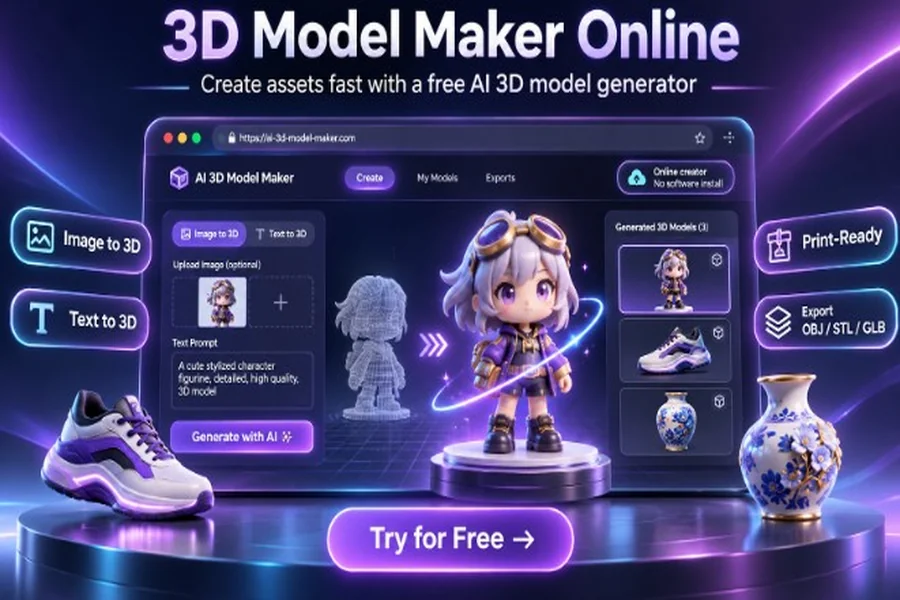
Creating three-dimensional digital objects has become easier with the rapid development of artificial intelligence. What once required advanced modeling skills, expensive software, and hours of manual work can now be approached through browser-based AI tools. Whether you are a beginner exploring 3D design, a digital artist developing creative assets, or a business owner creating product visuals, modern AI solutions offer new ways to bring ideas into three dimensions. A powerful 3D model maker online can help users generate 3D objects from different types of input without installing complicated desktop applications. With the growing availability of a free AI 3D model generator, creating digital models is becoming more accessible to people with different levels of technical experience.
In this article, we will explore how online 3D modeling tools work, what AI can do for digital creators, and how to choose the right platform for your projects.
What Is a 3D Model Maker Online?
A 3D model maker online is a web-based tool that allows users to create, generate, or modify three-dimensional digital objects through an internet browser. Unlike traditional desktop software, these platforms do not always require users to install large applications or configure complicated environments.
Depending on the platform, users may be able to create models using:
- Text descriptions and creative prompts.
- Uploaded photographs and reference images.
- Existing 3D objects.
- AI-assisted generation tools.
- Built-in editing and customization features.
For example, a user interested in creating a decorative sculpture can provide a visual reference or describe the desired object. An AI-powered platform can then help generate a corresponding 3D representation.
This approach makes 3D design more approachable for beginners while offering experienced creators additional ways to accelerate their workflows.
How Does an Online AI 3D Model Maker Work?
AI-powered 3D modeling platforms use machine learning techniques to interpret input information and generate three-dimensional structures. Although the underlying technology varies between platforms, the general process usually involves several stages.
1. Provide Your Input
The first step is selecting the type of input supported by the platform. Some tools accept text prompts, while others allow users to upload images or provide existing 3D assets.
A detailed description or clear reference image can help the AI understand the intended object.
2. AI Analysis and Interpretation
The system analyzes the submitted information to identify important visual characteristics, including shapes, proportions, object boundaries, and surface details.
For image-based generation, AI attempts to estimate the object’s depth and three-dimensional structure from the available visual information.
3. Generate the 3D Model
After analyzing the input, the system generates a three-dimensional representation. Depending on the technology, this may include geometry, surface details, and visual characteristics that make the object recognizable.
4. Review and Refine
Once generation is complete, users can inspect the result. Some platforms offer additional options for adjusting the appearance, improving details, or preparing the model for other applications.
5. Export Your Model
The final step is downloading the generated asset in a supported file format. Depending on the platform, these files may be used in 3D design software, animation applications, game engines, or 3D printing workflows.
Why Choose a Free AI 3D Model Generator?
Traditional 3D modeling software can have a steep learning curve. Beginners often need to understand polygon modeling, mesh editing, UV mapping, materials, lighting, and rendering before producing professional-looking results.
A free AI 3D model generator offers an alternative starting point by automating parts of the creation process.
Here are some reasons why these tools are becoming increasingly popular.
Lower Entry Barriers: Beginners can experiment with 3D creation without first mastering complicated modeling techniques.
Faster Concept Development: AI can help transform initial ideas into visual representations, making it easier to explore different concepts.
Reduced Initial Costs: Free access or trial options allow users to explore AI-assisted modeling before committing to paid software.
Convenient Access: Browser-based platforms can make 3D creation accessible from different devices without requiring a complex installation process.
Creative Flexibility: Designers can experiment with characters, furniture, decorative objects, product concepts, and other digital assets.
However, free access does not necessarily mean unlimited generation. Some platforms may impose restrictions on credits, downloads, processing speed, or advanced features.
What Can You Create With an Online 3D Model Maker?
The applications of AI-powered 3D generation extend across several industries. The technology is useful not only for professional designers but also for independent creators, students, entrepreneurs, and hobbyists.
1. Characters and Digital Sculptures
Artists can explore character concepts, fantasy creatures, collectible figures, and decorative sculptures. AI-generated models can serve as starting points for more detailed creative work.
2. Product Design and Visualization
Businesses can create digital representations of products for presentations, prototypes, and marketing materials. This can help communicate design ideas before physical production begins.
3. Game Development
Game developers frequently need digital assets such as environmental objects, props, characters, and accessories. AI-assisted generation can help accelerate early-stage asset creation.
Generated models may still require topology optimization, retopology, and adjustments before being used in production-ready game environments.
4. Architecture and Interior Design
Designers can experiment with furniture, decorative objects, lighting fixtures, and other interior elements. Three-dimensional representations can help communicate design concepts more effectively.
5. Education and Creative Learning
Students can use AI-generated models to explore spatial relationships, object structures, and digital design principles. This makes 3D modeling an interesting learning opportunity for people who are new to the subject.
How to Get Better Results From a Free AI 3D Model Generator
Although AI automates several modeling tasks, the quality of the output still depends on the input and the capabilities of the generation system.
Consider these practical suggestions:
Use Clear Reference Images: If the platform supports image-based generation, choose photographs with good lighting, visible object boundaries, and minimal background distractions.
Write Specific Prompts: When using text-to-3D generation, describe the object’s shape, material, proportions, and important visual characteristics.
Start With Manageable Objects: Simple objects are generally easier to evaluate and refine than highly complicated structures.
Review Geometry Carefully: A model may look visually attractive but still contain unsuitable geometry for professional applications.
Check Export Compatibility: Make sure the downloaded model works with your preferred software or production workflow.
Experiment With Different Inputs: Small changes in descriptions or reference images can produce different results. Comparing outputs can help you identify the most suitable approach.
3D Model Maker Online vs. Traditional 3D Modeling Software
Both online AI tools and traditional modeling applications have useful roles in modern digital production. However, their workflows and capabilities are different.
| Feature | Online AI 3D Maker | Traditional 3D Software |
| Learning curve | Often beginner-friendly | Can be complex |
| Model generation | AI-assisted | Primarily manual or procedural |
| Initial workflow | Usually faster | Depends on project complexity |
| Customization | Depends on available features | Extensive control |
| Installation | Often browser-based | Usually requires installation |
| Professional refinement | May require additional software | Advanced editing capabilities |
An online AI model maker is particularly useful for rapid generation and experimentation. Traditional 3D software remains valuable when projects require precise geometry, detailed sculpting, advanced animation, or complete production control.
Many professional workflows benefit from combining both approaches.
What to Look for When Choosing an AI 3D Modeling Platform
Not every platform provides the same generation quality or features. Before choosing a solution, evaluate the following factors:
- Input Options: Check whether it supports text-to-3D, image-to-3D, or both.
- Generation Quality: Evaluate the shape accuracy, geometry, and surface details of generated models.
- Export Formats: Look for compatibility with common 3D file formats such as OBJ, STL, and GLB.
- Processing Speed: Consider how quickly the platform generates usable results.
- Free Usage Limits: Understand generation credits, download restrictions, and subscription requirements.
- Editing Capabilities: Additional customization options can be valuable for more advanced projects.
- Ease of Use: A simple interface can make the experience more accessible to beginners.
The right platform depends on your creative goals, technical requirements, and budget.
The Future of Online AI 3D Modeling
Artificial intelligence is changing the relationship between creative ideas and digital production. As generative technologies continue to improve, online 3D modeling platforms are expected to provide more accurate geometry, better surface details, and increasingly flexible customization options.
Future developments may also improve integration with animation software, game engines, virtual environments, and 3D printing applications.
This does not mean traditional modeling skills will become unnecessary. Professional creators will still need to understand geometry, materials, topology, lighting, and optimization. However, AI can reduce repetitive tasks and allow designers to focus more on creative decisions.
For beginners, these developments create an opportunity to explore 3D design without facing the same technical barriers that existed in the past.
Final Thoughts
Online AI-powered modeling tools are making three-dimensional design more accessible, convenient, and efficient. A 3D model maker online provides a practical way to experiment with digital objects, while a free AI 3D model generator can help beginners explore the possibilities of AI-assisted creation without immediately investing in expensive software.
From character design and game development to product visualization and digital art, these technologies offer valuable opportunities for creators with different goals and experience levels.
As AI continues to evolve, browser-based 3D generation will likely become an increasingly important part of modern creative workflows. Exploring these tools today can be a useful first step toward understanding the future of digital design.